
Grief Is Sacred
Grief is a funny thing.
I have heard so many things about grief over the years—that it comes in waves, that it doesn’t get smaller and you just build your life around it, that it lives with you at all times, that grief is the receipt for love, that there are stages you are supposed to move through.
All of them ring true to me in different ways.
People have been trying to put words to grief forever. I am not interested in making grief sound simple or digestible or neat. I don’t think it is meant to be. I think grief resists being summarized. I think grief is sacred.
It is so personal to each individual that we do it a disservice when we try to explain it too quickly or translate it for someone else. Grief does not ask to be understood the same way by everyone. It asks to be honored.
Grief. Is. Sacred.
There is something about being in the depths of grief that feels heavy and intimate and all-consuming in a way that is hard to compare to anything else. Not because it feels good—although sometimes it strangely can—but because it feels deeply personal, ever-changing, and impossible to fully articulate.
Have you ever tried to take a picture of something beautiful and felt disappointed by what the camera captured compared to what your eyes were seeing? You adjust the angle, the light, the settings, hoping the image will finally reflect what you’re experiencing—only to realize it never will. You end up saying, the picture doesn’t do it justice.
Grief is like that.
There are no words, no one-liners, no books that can take a heart full of love and loss—of joy and trauma, laughter and sorrow—and fully explain what grief looks like inside a person. I think people will keep trying, and grief will keep remaining personal. No one will ever be able to explain it for everyone else.
Grief is something you carry. Sometimes it is light enough to forget for a while. Sometimes it is heavy enough to take your breath away. Sometimes you can share the weight. Sometimes—even in a room full of people—you are the only one holding it.
It is always with you, one way or another.
Right now, the weight feels heavy.
As I move through grief with myself and my therapist, we often find ourselves circling back to my very first grief. That is one of the strange truths about grief—it isn’t always about what it appears to be about.
I can grieve the loss of my dog and find myself crying about my dad within seconds. When I think about losing my dad, I am suddenly nine years old again. I can move from being forty to being nine in an instant. I can go from decades removed to moments removed.
Grief collapses time.
It holds the present and the past at the same time.
Frozen either way.
Grief can make me appreciate life while also being afraid of it. It can draw me closer to God and closer to myself, while also making me angry at both. It can leave quietly and return without warning. It can swell and crash in the same breath.
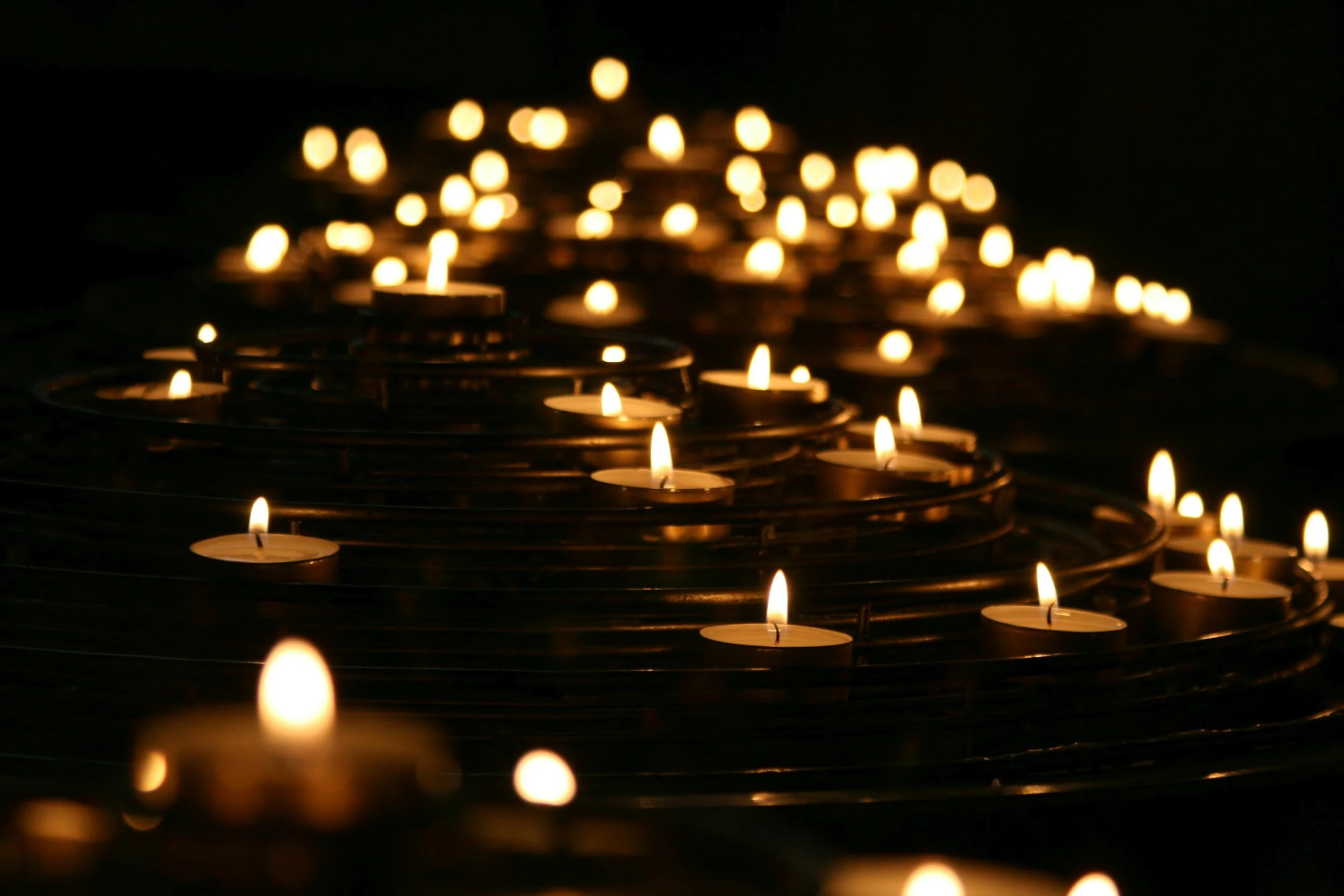
Grief can make me want to light candles and crawl under a blanket and let the world be small for a while—something that feels sacred in its own way. It can also make me feel like I need to prove that I am okay, that I am functioning, that I am still standing.
Grief contradicts itself. It tells the truth in opposing directions at once. And because of that, it is nearly impossible to explain.
When people say they understand, or that they relate, I know what they are often trying to offer—closeness, comfort, solidarity. And sometimes that helps. But sometimes it feels like grief is being translated too quickly, smoothed out, made familiar when it isn’t meant to be.
Grief does not need to be shared to be valid. It does not need comparison to be real.
Grief is deeply personal. And it is also quietly universal. It belongs to you alone, and yet it places you among countless others who are carrying something tender and heavy in their own way.
So if you carry grief—
If you think grief that is years or decades old shouldn’t still land the way it does.
If it makes you want to be alone one moment and surrounded by people the next.
If it makes you want to shut everyone out and then let everyone in.
If it makes you feel close to yourself and far from yourself at the same time.
If it looks like tears one moment and numbness the next.
Then know this:
You are not alone in carrying it.
And you do not have to explain it.
Grief does not need to be understood to be honored. It does not need to look like anyone else’s to be real.
It is yours.
And that does not make it lonely.
It makes it human.
Keep Reading
If this reflection met you in a tender place, you might also like:
→ God and I Are at an Impasse – when faith feels quiet and far away
→ Faith – choosing trust even when it feels fragile
→ Curiosity as a Wall – the ways we protect ourselves from feeling too much
